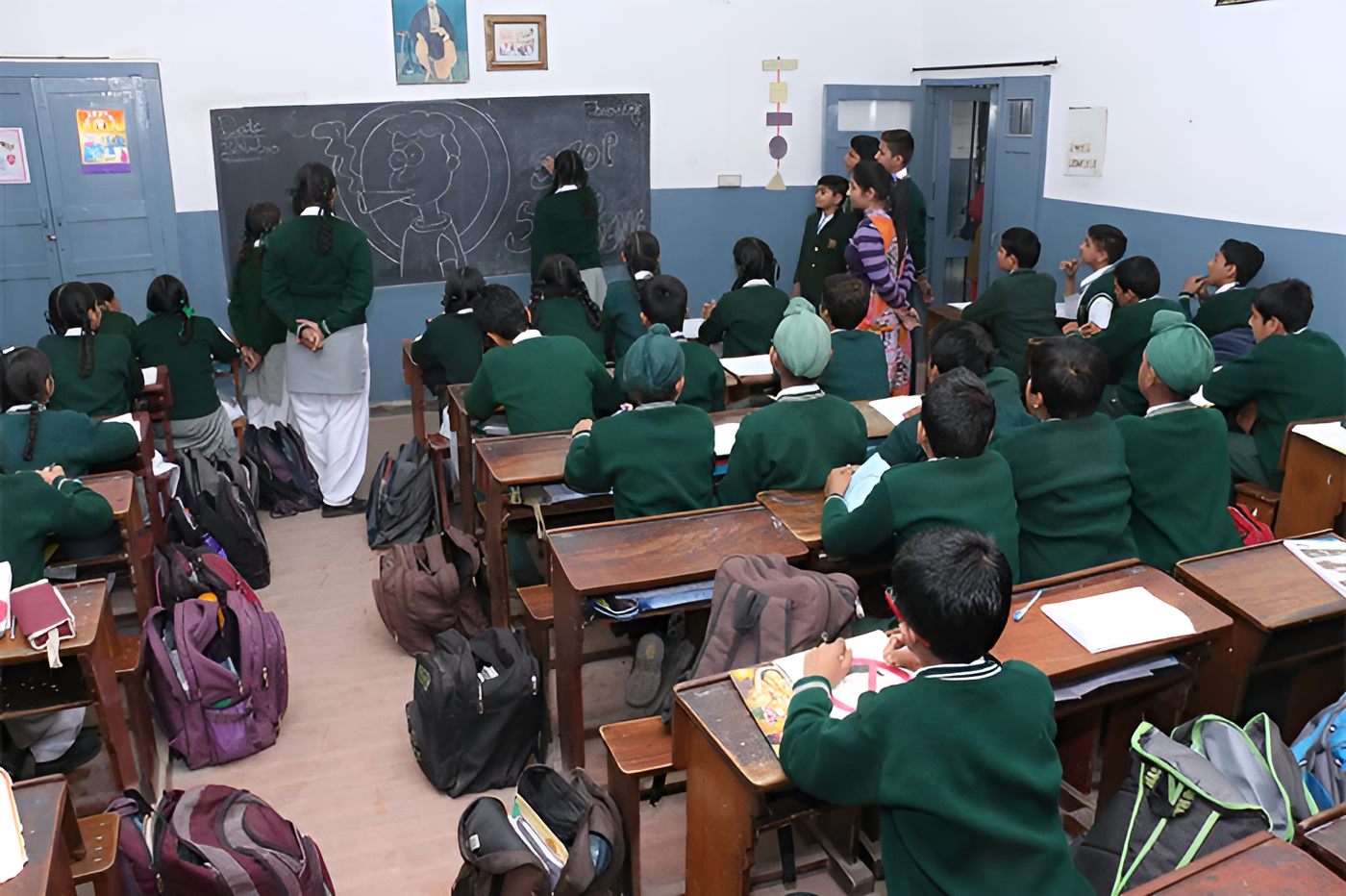
Well-lit Classrooms
Spacious, well-ventilated classrooms equipped with modern teaching aids to facilitate effective learning.
Academics & Salient Features
The PSEB curriculum from Nursery to Class XII, taught in classrooms built for light, laboratories built for experiment, and a Yajyashala that keeps the school’s founding purpose in the middle of the working day.
Our Approach
We follow a joyful, experience-based learning system in which every child is encouraged to participate whole-heartedly. Our distinctive academic programmes and innovative teaching methodologies connect students to real-life experience, so that they become critical thinkers and creative problem-solvers rather than good at memorising.
The academic programme follows the PSEB pattern, so that a student here sits comfortably in any Punjab classroom — and, with laboratory work, computer literacy and language training, in any classroom outside it.
Stages & Subjects
The school admits students from three years old to Class XII. Each stage has its own rhythm, its own assessment, and its own idea of what a child should be able to do by the end of it.
Nursery · L.K.G. · U.K.G. · Ages 3 to 6
The school admits tiny tots in the Nursery class on the basis of interaction with the parents and their ward; the child should have recognition abilities for common objects. A written or oral test may be taken. The first years are about language, number, movement and confidence — not about syllabus.
What we watch for
At this age the school looks for curiosity, willingness to try, and the ability to separate from a parent without distress. Those three things predict academic comfort better than any early test result.
Classes I to VIII · Entrance test for admission
Admission to all high classes is done on the basis of an entrance test. The middle years build the core: four languages, mathematics, science and social studies, with computer, art, music and sports alongside. Sanskrit continues through the stage, supported by the Yajyashala.
| Group | Subjects |
|---|---|
| Languages | English, Hindi, Punjabi, Sanskrit |
| Sciences & Mathematics | Mathematics, Science, Computer |
| Social Studies | History, Geography, Civics |
| Arts & Activity | Art, Music, Sports, Life Skills |
Classes IX to XII · Science, Commerce & Humanities at XI
Admission to Class XI (Science, Commerce & Humanities) is done in the month of April, purely on the basis of performance in the pre-board marks of the entrance test conducted by the school. Students from other schools appear for a written entrance test and an interaction with both parents. The final decision of admission rests with the Principal, subject to availability of seats.
| Stream | Core subjects |
|---|---|
| Science | Physics, Chemistry, Biology / Mathematics |
| Commerce | Accountancy, Business Studies, Economics |
| Humanities | History, Political Science, Economics, Sociology |
A visit to the school, or a call to the office, to understand the stage your child will enter.
Forms are issued at the school office against the required documents.
Interaction, or an entrance test, depending on the class being applied for.
Admission is confirmed by the school, and the diary and uniform follow.
Salient Features
Every facility below has a purpose in the timetable or in the school’s care of a child’s day.
Spacious, well-ventilated classrooms equipped with modern teaching aids to facilitate effective learning.
Advanced laboratories for Physics, Chemistry and Biology, designed for hands-on experiments and scientific exploration.
Equipped with the latest technology, providing students with advanced computer education and digital literacy skills.
Three resourceful libraries to support academic growth and general reading.
A well-equipped auditorium for school events, performances and assemblies, fostering cultural and academic engagement.
A dedicated space to inculcate Vedic culture through rituals and teachings, promoting traditional values.
A modern conference hall for meetings, workshops and seminars, with a sitting capacity of 350 children.
A room with indoor games such as chess, and well equipped for outdoor games as well.
An on-campus, well-equipped homeopathic clinic providing immediate medicine.
A beautifully maintained, lush green lawn for relaxation, outdoor activity, and a closer relationship with nature.
A welcoming reception area designed to assist visitors, parents and students in a warm and professional atmosphere.
A daily diary for every student, checked and signed by a parent, and monthly report records for continuous correction.
Assessment
Assessment in this school is continuous and visible to the family. Tests are frequent enough to catch a difficulty early, and reports are handed over only to parents, at the Parent–Teacher Meeting.
At a glance
| Nursery – U.K.G. | Interaction with child and parents; written or oral test if required |
|---|---|
| Classes I – IX | Entrance test for admission; monthly test and terminal examination thereafter |
| Class XI | School entrance test, pre-board marks, and interaction with both parents |
| Classes IX – X | Pre-board examination, followed by the PSEB board examination |
| Report card | Signed by the parent and returned to the teacher in-charge |
Beyond the Classroom
The auditorium, the conference hall, the lawn and the sports room are not extras. They are where a student learns to perform, to lose gracefully, and to work in a team.
Annual sports day, indoor games in the sports room, and outdoor games on the grounds. Athletics, cricket, football, badminton, kho-kho and kabaddi.
Music and dance performances, art exhibitions, the Annual Day, and celebration of occasions such as Gurpurab through shabad ucharan.
Science fairs, model presentations, quizzes and exhibitions where students show what they have built and learned.
Daily shloka recitation, the Yajyashala, Sanskrit competitions, and value education that keeps the school’s founding purpose active.
Morning assembly, the 350-seat conference hall for workshops, seminars and inter-school competitions, and parent–teacher meetings.
Students are encouraged to become agents of transformation in the community — the same thought that closes the Director’s message.